CelClear™ O2 Sensor Spacer — Kill the Check Engine Light Without Pulling the Cat
Kill That P0420 Check Engine Light Without Replacing Your Catalytic Converter
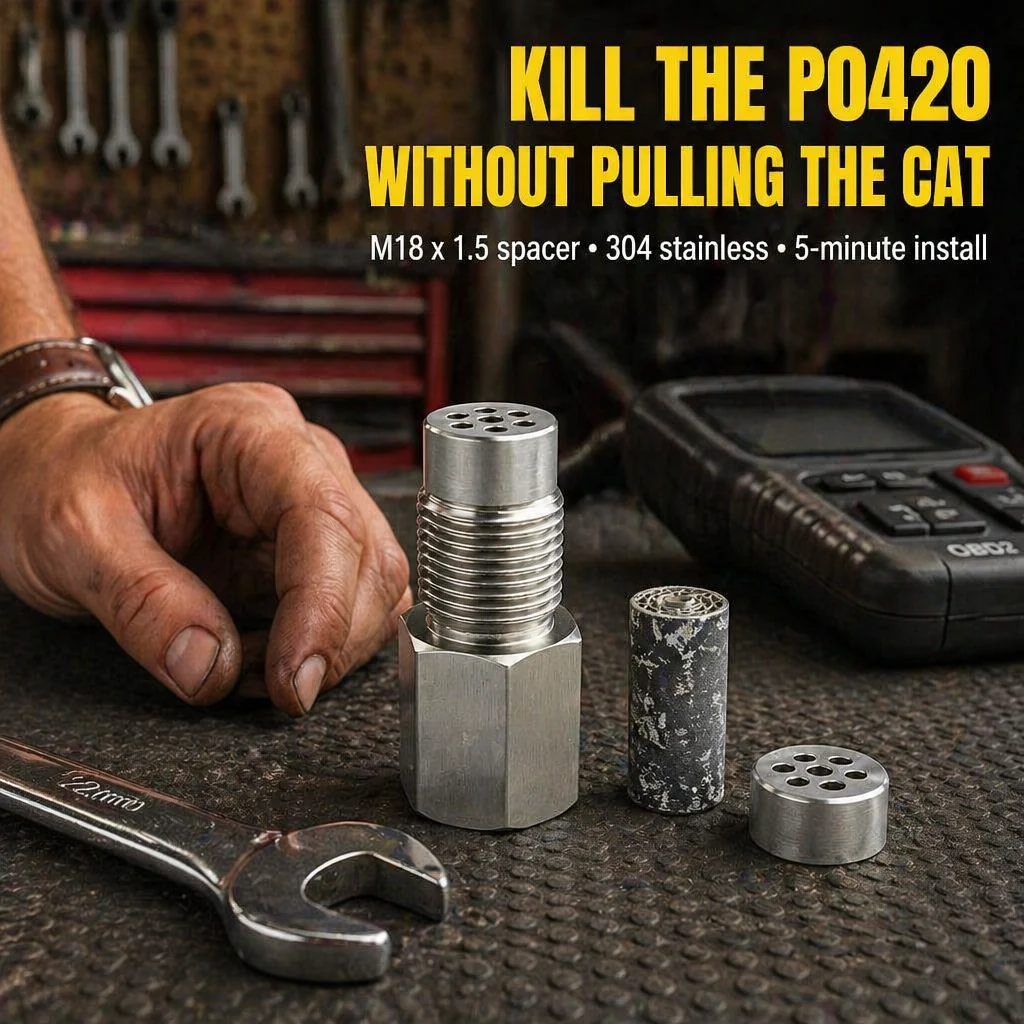
CelClear™ is the M18*1.5 O2 sensor spacer mechanics use to fix a stuck check engine light without ripping out the cat or buying a new one. Threads in with one wrench in under 5 minutes, drops the downstream sensor out of direct exhaust flow, and gives your ECU the reading it expects. Real 304 stainless steel. Fits 99% of cars, SUVs, and sports cars with a standard M18*1.5 sensor port.

Stop Throwing $1,800 at a Check Engine Light That Keeps Coming Back
You cleared the code with an OBD2 reader. It came back in 50 miles. The dealer quoted you $1,800 for a new catalytic converter on a car that runs fine. A spark plug non-fouler from the parts store didn't even thread in — wrong size. Inspection's in two weeks and you're out of cheap options.
➤ Pulls the O2 Sensor Out of Direct Exhaust Flow: The precision-cast filter insert sits between the sensor tip and the gas stream, so the sensor reads diluted, post-catalyst-style gas instead of raw exhaust. ECU sees what it expects, P0420 stays gone.
➤ M18*1.5 Universal Thread Fits 99% of Modern Vehicles: Standard downstream O2 sensor thread on Audi, BMW, Subaru, Honda, Toyota, Ford, VW, Land Rover and more. If your car runs an M18*1.5 port, this drops in. No adapters, no thread tape gymnastics.
➤ 304 Stainless That Handles 700°C Without Warping: Rated -40°C to 700°C, corrosion-resistant, anti-rust. Survives daily driving, cold starts, summer traffic, and harder pulls. Cheap zinc spacers strip threads or melt — this one doesn't.

The Mini-Cat Insert That Tells Your ECU Everything's Fine
Your ECU compares the upstream and downstream O2 sensors. The cat is supposed to clean the exhaust between them — when it can't (aging cat, deleted cat, high-flow downpipe), the downstream sensor reads too rich and triggers P0420. CelClear™ threads in between the sensor and the exhaust port, with a precision-cast filter that holds a small pocket of post-cat-style gas at the sensor tip.
Spark plug non-foulers try to do the same thing with a hollow tube and the wrong thread. They miss the mark on newer cars and often don't move the sensor far enough off the flow. CelClear™ is built for the M18*1.5 spec your car actually uses, with a real filter element machined to dilute the gas reading the way your ECU was designed to see it.

Why DIY Mechanics and Weekend Wrenches Keep CelClear™ in the Toolbox
If you've spent any time on car forums looking for the cheap fix, you've seen the spacer route recommended a hundred times. CelClear™ is the version built right — proper M18*1.5 threads, real stainless, a filter insert that does the job. "Drove three weeks with the CEL on after my downpipe install. Threaded CelClear™ in, did 80 miles, light's gone. Hasn't come back in four months." — Marcus T.

Pass Inspection, Save the $1,800, Get the Light Off Tonight
✓ Pass Inspection Without a Cat Replacement: Most state inspections only check that the CEL is off and no codes are stored. Kill the light, drive the readiness cycle, pass.
✓ Five-Minute Install with One 22mm Wrench: One wrench, a stretch of warm exhaust, and you're done. No welding, no tune, no shop appointment, no lift.
✓ Holds Up Through Heat, Cold, and Hard Driving: 304 stainless rated to 700°C — survives city heat soak, winter cold starts, and spirited drives without warping or rusting through.
3-Step Install — One Wrench, Five Minutes
Step 1: Unscrew your downstream O2 sensor with a 22mm wrench. Wait until the exhaust is warm but not hot — threads come out cleaner.
Step 2: Thread CelClear™ directly into the empty O2 bung. Hand-tight first, then snug it with the wrench until firm.
Step 3: Screw your O2 sensor back into the top of CelClear™. Start the car, drive 50–80 miles to clear the code. CEL gone.

| CelClear™ | Spark Plug Non-Fouler | New Catalytic Converter |
|---|---|---|
| M18*1.5 thread — fits 99% of vehicles | ❌ 18mm spark plug thread, wrong size for most modern cars | ❌ Replaces a part that's still working fine |
| Filter insert dilutes sensor reading properly | ❌ Hollow tube, often doesn't clear the code | ✅ Works, but $800–$2,000 installed |
| 304 stainless rated to 700°C | ❌ Zinc or aluminum, can melt or strip | ✅ OEM-grade material |
| Install in 5 minutes, one wrench | ❌ Quick install but unreliable on newer cars | ❌ Hours of labor + shop fees |
Full Specs for the Detail-Checkers
- Thread: M18 x 1.5mm — standard downstream O2 sensor thread
- Material: 304 stainless steel body + precision-cast filter insert
- Temperature range: -40°C to 700°C (-40°F to 1292°F)
- What's included: 1x CelClear™ adapter body, 1x filter element
- Compatibility: 99% of vehicles with M18 x 1.5 O2 sensor ports — Audi, BMW, Subaru, Honda, Toyota, Ford, VW, Land Rover, and most others
Got Questions? Here's What You Need to Know
Will this fit my car?
If your downstream O2 sensor uses an M18 x 1.5 thread — which is true for around 99% of cars built after 2000 — yes. Pull the sensor and check the threads, or look up your model in a sensor cross-reference. Spark plug non-foulers (18mm) won't fit; this is the correct size.
Is it real 304 stainless or cheap pot metal?
Real 304 stainless steel. A magnet won't grip it strongly. Rated -40°C to 700°C, corrosion-resistant, anti-rust. Same grade used in proper exhaust hardware.
Will the check engine light come back?
Once the code clears (usually 50–80 miles of mixed driving after install), it stays off in the vast majority of cases. Some cars need a longer drive cycle to mark readiness — be patient and drive it normally. If your underlying issue is something other than O2 readings (misfire, EVAP, etc.), that'll need to be addressed separately.
What if I drive hard or track the car?
700°C is hotter than what a downstream O2 sensor port normally sees, even on a hard pull. The 304 spec was chosen specifically so the spacer doesn't become the weak link.
What if it doesn't work on my car?
Reach out and we'll make it right — refund or replacement until it's sorted. See the guarantee below.

If CelClear™ Doesn't Kill the Light, We'll Make It Right
Install CelClear™, drive your readiness cycle, and if the check engine light isn't gone, contact us. We'll work with you on a refund or replacement until it's sorted. The whole point of this product is the cheap fix that actually works — and we stand behind that.
Kill That P0420 Check Engine Light Without Replacing Your Catalytic Converter
CelClear™ is the M18*1.5 O2 sensor spacer mechanics use to fix a stuck check engine light without ripping out the cat or buying a new one. Threads in with one wrench in under 5 minutes, drops the downstream sensor out of direct exhaust flow, and gives your ECU the reading it expects. Real 304 stainless steel. Fits 99% of cars, SUVs, and sports cars with a standard M18*1.5 sensor port.
Stop Throwing $1,800 at a Check Engine Light That Keeps Coming Back
You cleared the code with an OBD2 reader. It came back in 50 miles. The dealer quoted you $1,800 for a new catalytic converter on a car that runs fine. A spark plug non-fouler from the parts store didn't even thread in — wrong size. Inspection's in two weeks and you're out of cheap options.
➤ Pulls the O2 Sensor Out of Direct Exhaust Flow: The precision-cast filter insert sits between the sensor tip and the gas stream, so the sensor reads diluted, post-catalyst-style gas instead of raw exhaust. ECU sees what it expects, P0420 stays gone.
➤ M18*1.5 Universal Thread Fits 99% of Modern Vehicles: Standard downstream O2 sensor thread on Audi, BMW, Subaru, Honda, Toyota, Ford, VW, Land Rover and more. If your car runs an M18*1.5 port, this drops in. No adapters, no thread tape gymnastics.
➤ 304 Stainless That Handles 700°C Without Warping: Rated -40°C to 700°C, corrosion-resistant, anti-rust. Survives daily driving, cold starts, summer traffic, and harder pulls. Cheap zinc spacers strip threads or melt — this one doesn't.
The Mini-Cat Insert That Tells Your ECU Everything's Fine
Your ECU compares the upstream and downstream O2 sensors. The cat is supposed to clean the exhaust between them — when it can't (aging cat, deleted cat, high-flow downpipe), the downstream sensor reads too rich and triggers P0420. CelClear™ threads in between the sensor and the exhaust port, with a precision-cast filter that holds a small pocket of post-cat-style gas at the sensor tip.
Spark plug non-foulers try to do the same thing with a hollow tube and the wrong thread. They miss the mark on newer cars and often don't move the sensor far enough off the flow. CelClear™ is built for the M18*1.5 spec your car actually uses, with a real filter element machined to dilute the gas reading the way your ECU was designed to see it.
Why DIY Mechanics and Weekend Wrenches Keep CelClear™ in the Toolbox
If you've spent any time on car forums looking for the cheap fix, you've seen the spacer route recommended a hundred times. CelClear™ is the version built right — proper M18*1.5 threads, real stainless, a filter insert that does the job. "Drove three weeks with the CEL on after my downpipe install. Threaded CelClear™ in, did 80 miles, light's gone. Hasn't come back in four months." — Marcus T.
Pass Inspection, Save the $1,800, Get the Light Off Tonight
✓ Pass Inspection Without a Cat Replacement: Most state inspections only check that the CEL is off and no codes are stored. Kill the light, drive the readiness cycle, pass.
✓ Five-Minute Install with One 22mm Wrench: One wrench, a stretch of warm exhaust, and you're done. No welding, no tune, no shop appointment, no lift.
✓ Holds Up Through Heat, Cold, and Hard Driving: 304 stainless rated to 700°C — survives city heat soak, winter cold starts, and spirited drives without warping or rusting through.
3-Step Install — One Wrench, Five Minutes
Step 1: Unscrew your downstream O2 sensor with a 22mm wrench. Wait until the exhaust is warm but not hot — threads come out cleaner.
Step 2: Thread CelClear™ directly into the empty O2 bung. Hand-tight first, then snug it with the wrench until firm.
Step 3: Screw your O2 sensor back into the top of CelClear™. Start the car, drive 50–80 miles to clear the code. CEL gone.
| CelClear™ | Spark Plug Non-Fouler | New Catalytic Converter |
|---|---|---|
| M18*1.5 thread — fits 99% of vehicles | ❌ 18mm spark plug thread, wrong size for most modern cars | ❌ Replaces a part that's still working fine |
| Filter insert dilutes sensor reading properly | ❌ Hollow tube, often doesn't clear the code | ✅ Works, but $800–$2,000 installed |
| 304 stainless rated to 700°C | ❌ Zinc or aluminum, can melt or strip | ✅ OEM-grade material |
| Install in 5 minutes, one wrench | ❌ Quick install but unreliable on newer cars | ❌ Hours of labor + shop fees |
Full Specs for the Detail-Checkers
- Thread: M18 x 1.5mm — standard downstream O2 sensor thread
- Material: 304 stainless steel body + precision-cast filter insert
- Temperature range: -40°C to 700°C (-40°F to 1292°F)
- What's included: 1x CelClear™ adapter body, 1x filter element
- Compatibility: 99% of vehicles with M18 x 1.5 O2 sensor ports — Audi, BMW, Subaru, Honda, Toyota, Ford, VW, Land Rover, and most others
Got Questions? Here's What You Need to Know
Will this fit my car?
If your downstream O2 sensor uses an M18 x 1.5 thread — which is true for around 99% of cars built after 2000 — yes. Pull the sensor and check the threads, or look up your model in a sensor cross-reference. Spark plug non-foulers (18mm) won't fit; this is the correct size.
Is it real 304 stainless or cheap pot metal?
Real 304 stainless steel. A magnet won't grip it strongly. Rated -40°C to 700°C, corrosion-resistant, anti-rust. Same grade used in proper exhaust hardware.
Will the check engine light come back?
Once the code clears (usually 50–80 miles of mixed driving after install), it stays off in the vast majority of cases. Some cars need a longer drive cycle to mark readiness — be patient and drive it normally. If your underlying issue is something other than O2 readings (misfire, EVAP, etc.), that'll need to be addressed separately.
What if I drive hard or track the car?
700°C is hotter than what a downstream O2 sensor port normally sees, even on a hard pull. The 304 spec was chosen specifically so the spacer doesn't become the weak link.
What if it doesn't work on my car?
Reach out and we'll make it right — refund or replacement until it's sorted. See the guarantee below.
If CelClear™ Doesn't Kill the Light, We'll Make It Right
Install CelClear™, drive your readiness cycle, and if the check engine light isn't gone, contact us. We'll work with you on a refund or replacement until it's sorted. The whole point of this product is the cheap fix that actually works — and we stand behind that.
Original: $19.99
-70%$19.99
$6.00Description
Kill That P0420 Check Engine Light Without Replacing Your Catalytic Converter
CelClear™ is the M18*1.5 O2 sensor spacer mechanics use to fix a stuck check engine light without ripping out the cat or buying a new one. Threads in with one wrench in under 5 minutes, drops the downstream sensor out of direct exhaust flow, and gives your ECU the reading it expects. Real 304 stainless steel. Fits 99% of cars, SUVs, and sports cars with a standard M18*1.5 sensor port.
Stop Throwing $1,800 at a Check Engine Light That Keeps Coming Back
You cleared the code with an OBD2 reader. It came back in 50 miles. The dealer quoted you $1,800 for a new catalytic converter on a car that runs fine. A spark plug non-fouler from the parts store didn't even thread in — wrong size. Inspection's in two weeks and you're out of cheap options.
➤ Pulls the O2 Sensor Out of Direct Exhaust Flow: The precision-cast filter insert sits between the sensor tip and the gas stream, so the sensor reads diluted, post-catalyst-style gas instead of raw exhaust. ECU sees what it expects, P0420 stays gone.
➤ M18*1.5 Universal Thread Fits 99% of Modern Vehicles: Standard downstream O2 sensor thread on Audi, BMW, Subaru, Honda, Toyota, Ford, VW, Land Rover and more. If your car runs an M18*1.5 port, this drops in. No adapters, no thread tape gymnastics.
➤ 304 Stainless That Handles 700°C Without Warping: Rated -40°C to 700°C, corrosion-resistant, anti-rust. Survives daily driving, cold starts, summer traffic, and harder pulls. Cheap zinc spacers strip threads or melt — this one doesn't.
The Mini-Cat Insert That Tells Your ECU Everything's Fine
Your ECU compares the upstream and downstream O2 sensors. The cat is supposed to clean the exhaust between them — when it can't (aging cat, deleted cat, high-flow downpipe), the downstream sensor reads too rich and triggers P0420. CelClear™ threads in between the sensor and the exhaust port, with a precision-cast filter that holds a small pocket of post-cat-style gas at the sensor tip.
Spark plug non-foulers try to do the same thing with a hollow tube and the wrong thread. They miss the mark on newer cars and often don't move the sensor far enough off the flow. CelClear™ is built for the M18*1.5 spec your car actually uses, with a real filter element machined to dilute the gas reading the way your ECU was designed to see it.
Why DIY Mechanics and Weekend Wrenches Keep CelClear™ in the Toolbox
If you've spent any time on car forums looking for the cheap fix, you've seen the spacer route recommended a hundred times. CelClear™ is the version built right — proper M18*1.5 threads, real stainless, a filter insert that does the job. "Drove three weeks with the CEL on after my downpipe install. Threaded CelClear™ in, did 80 miles, light's gone. Hasn't come back in four months." — Marcus T.
Pass Inspection, Save the $1,800, Get the Light Off Tonight
✓ Pass Inspection Without a Cat Replacement: Most state inspections only check that the CEL is off and no codes are stored. Kill the light, drive the readiness cycle, pass.
✓ Five-Minute Install with One 22mm Wrench: One wrench, a stretch of warm exhaust, and you're done. No welding, no tune, no shop appointment, no lift.
✓ Holds Up Through Heat, Cold, and Hard Driving: 304 stainless rated to 700°C — survives city heat soak, winter cold starts, and spirited drives without warping or rusting through.
3-Step Install — One Wrench, Five Minutes
Step 1: Unscrew your downstream O2 sensor with a 22mm wrench. Wait until the exhaust is warm but not hot — threads come out cleaner.
Step 2: Thread CelClear™ directly into the empty O2 bung. Hand-tight first, then snug it with the wrench until firm.
Step 3: Screw your O2 sensor back into the top of CelClear™. Start the car, drive 50–80 miles to clear the code. CEL gone.
| CelClear™ | Spark Plug Non-Fouler | New Catalytic Converter |
|---|---|---|
| M18*1.5 thread — fits 99% of vehicles | ❌ 18mm spark plug thread, wrong size for most modern cars | ❌ Replaces a part that's still working fine |
| Filter insert dilutes sensor reading properly | ❌ Hollow tube, often doesn't clear the code | ✅ Works, but $800–$2,000 installed |
| 304 stainless rated to 700°C | ❌ Zinc or aluminum, can melt or strip | ✅ OEM-grade material |
| Install in 5 minutes, one wrench | ❌ Quick install but unreliable on newer cars | ❌ Hours of labor + shop fees |
Full Specs for the Detail-Checkers
- Thread: M18 x 1.5mm — standard downstream O2 sensor thread
- Material: 304 stainless steel body + precision-cast filter insert
- Temperature range: -40°C to 700°C (-40°F to 1292°F)
- What's included: 1x CelClear™ adapter body, 1x filter element
- Compatibility: 99% of vehicles with M18 x 1.5 O2 sensor ports — Audi, BMW, Subaru, Honda, Toyota, Ford, VW, Land Rover, and most others
Got Questions? Here's What You Need to Know
Will this fit my car?
If your downstream O2 sensor uses an M18 x 1.5 thread — which is true for around 99% of cars built after 2000 — yes. Pull the sensor and check the threads, or look up your model in a sensor cross-reference. Spark plug non-foulers (18mm) won't fit; this is the correct size.
Is it real 304 stainless or cheap pot metal?
Real 304 stainless steel. A magnet won't grip it strongly. Rated -40°C to 700°C, corrosion-resistant, anti-rust. Same grade used in proper exhaust hardware.
Will the check engine light come back?
Once the code clears (usually 50–80 miles of mixed driving after install), it stays off in the vast majority of cases. Some cars need a longer drive cycle to mark readiness — be patient and drive it normally. If your underlying issue is something other than O2 readings (misfire, EVAP, etc.), that'll need to be addressed separately.
What if I drive hard or track the car?
700°C is hotter than what a downstream O2 sensor port normally sees, even on a hard pull. The 304 spec was chosen specifically so the spacer doesn't become the weak link.
What if it doesn't work on my car?
Reach out and we'll make it right — refund or replacement until it's sorted. See the guarantee below.
If CelClear™ Doesn't Kill the Light, We'll Make It Right
Install CelClear™, drive your readiness cycle, and if the check engine light isn't gone, contact us. We'll work with you on a refund or replacement until it's sorted. The whole point of this product is the cheap fix that actually works — and we stand behind that.